
Safer because busier
November 12, 2025 · 2 min read
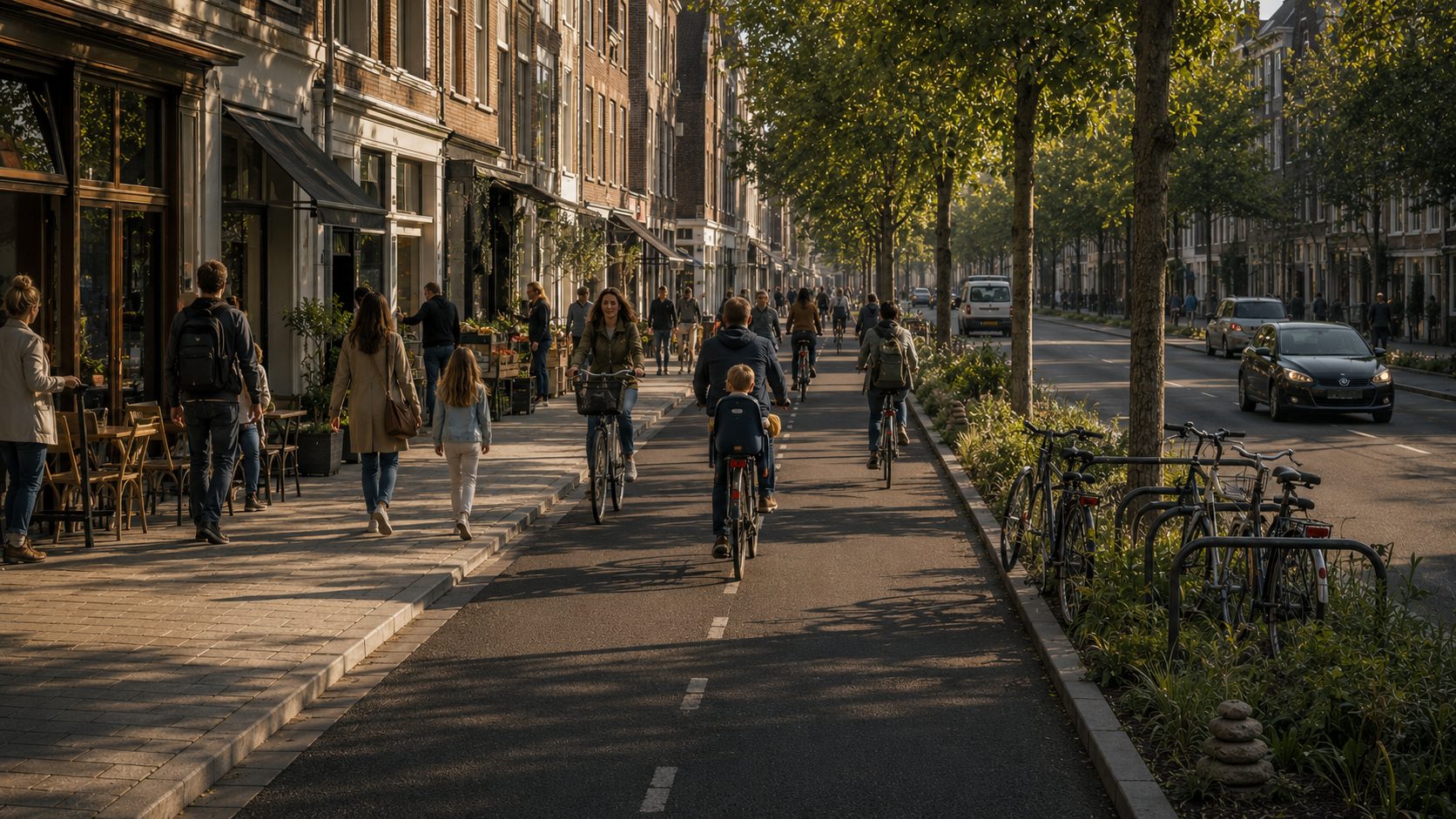
Here is one of the most counterintuitive findings in street safety, replicated across countries and decades: as the number of people walking and cycling rises, the risk to each individual person falls.
The relationship is precise enough to state as a rule. Crashes scale at roughly the 0.4 power of exposure, which means a 10 percent increase in cycling is associated with only about a 4 percent increase in crashes. Double the riders, and each rider's risk drops by roughly a third.
10% → 4%
A 10 percent rise in cycling is associated with only about a 4 percent rise in crashes. Each rider makes the next one safer.
Source: Jacobsen, Injury Prevention, 2003
The proposed mechanism is learning: drivers who encounter people on foot and on bikes at every corner begin to expect them at the next one, and drivers who expect a cyclist behave differently from drivers surprised by one.
The Netherlands is the long version of this story. Over decades of building separated infrastructure, cycling volumes rose and cyclist deaths fell by around 80 percent. The US non-fatal cycling injury rate today sits roughly 30 times higher. The Dutch did both things at once: they built protection, and the protection built volume, and the volume itself became protective.
A flywheel, read from either end
This finding pairs with the protected-lane evidence. Separation makes riding feel possible for ordinary people; ordinary people riding makes every rider more expected; being expected is safety. Each turn of the wheel makes the next one easier, which is why places that start building rarely stop, and why the first protected route in a town matters beyond its own curb line.
What to apply
Building for volume is itself a safety strategy. For a town, that means the goal of a new route is the people it will add, and counting them is part of the project. For a developer or campus, it means the arrival paths that feel busy and watched-over by ordinary use are the safe ones. Design for the crowd you want, and the crowd protects itself.
The limit
This is a strong association across places and times, and the mechanism is still debated. It never argues for skipping infrastructure: the volumes that protect were built by protection first.
Sources: Jacobsen, Injury Prevention, 2003; Elvik and Bjørnskau, 2017; Buehler and Pucher, 2021.