
The lane that paint could not build
December 9, 2025 · 2 min read
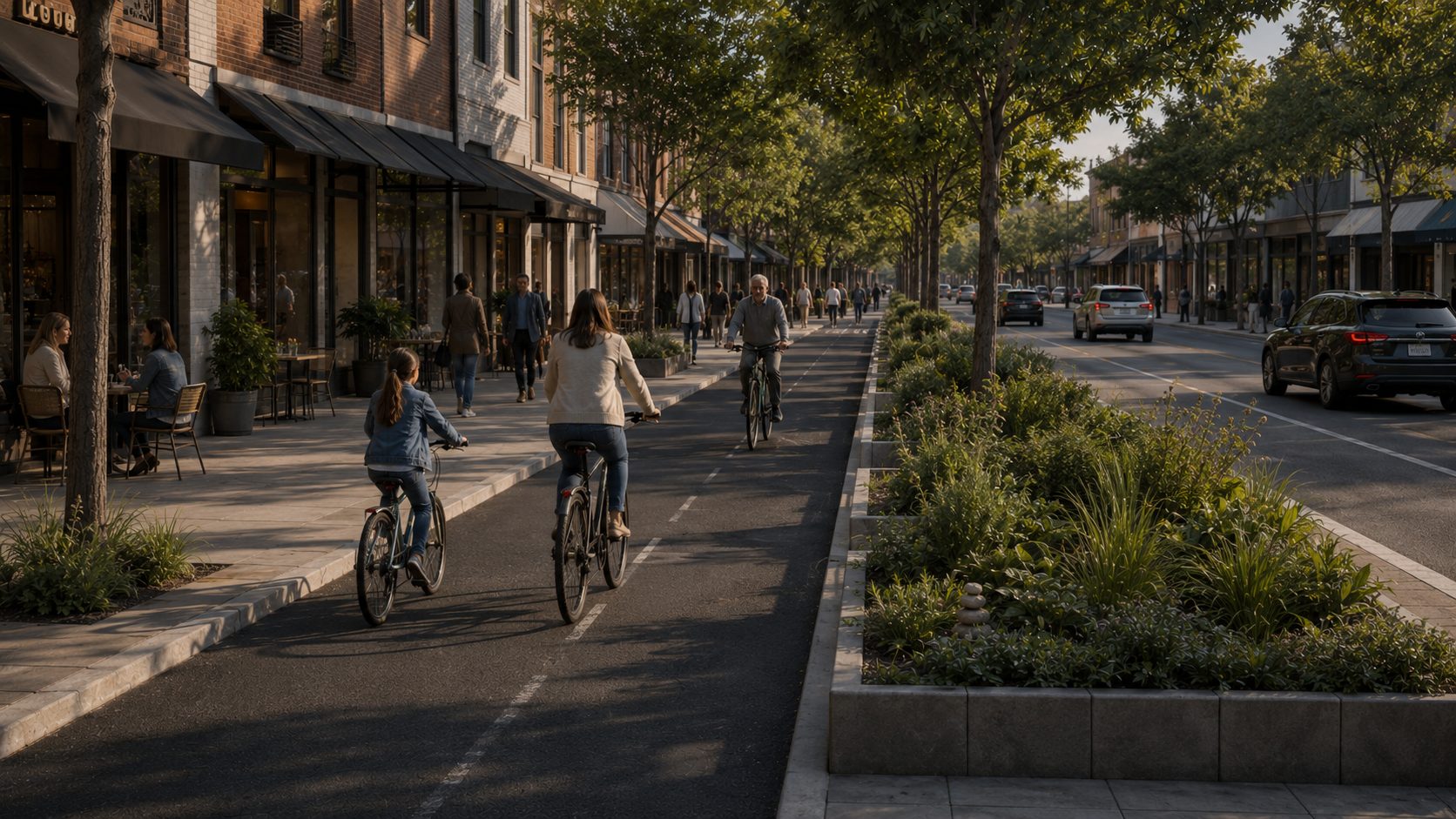
For decades, the standard way to add a bike lane was a stripe of paint. It was cheap, fast, and it looked like progress. Then researchers followed 12 large US cities for 13 years and measured what actually changed.
The cities that built protected and separated bicycle facilities, lanes with curbs, planters or parked cars between riders and traffic, saw large declines in road-fatality rates for all users: 61 percent in Seattle, 49 percent in San Francisco, 40 percent in Denver. Painted lanes showed no safety benefit at all. Sharrows, the painted arrows that ask riders and drivers to share, were associated with worse outcomes than doing nothing.
The pattern holds at the scale of a single street. Curb- or barrier-separated tracks cut a rider's injury odds by roughly 40 to 65 percent compared with no infrastructure, while advisory painted lanes were associated with about a 34 percent increase in injury odds.
−61%
Seattle's road-fatality rate for all users across 13 years of building protected lanes. Paint showed no benefit.
Source: Marshall and Ferenchak, 2019
Why protection helps the people who never ride
The most striking part of the 12-city finding is who benefited: everyone. Physical protection narrows the roadway and signals a calmer street, so all traffic slows. The lane built for cyclists quietly does the work of a traffic-calming project. And a lane that a parent would let a twelve-year-old use is what turns cycling from a brave choice into an ordinary one, which is where mode shift actually comes from.
What to apply
When the budget forces a choice, separation on fewer streets beats paint on many. Treat the level of protection as the design decision, and carry it through the intersections, where geometry decides the outcome: well-designed protected corners cut crashes by about a third in evaluations, while poorly chosen layouts made things worse.
The limit
The city-level percentages are associations across 13 years of city panel data, and no single corridor should be promised those numbers. Effects depend on how much network gets built and how the intersections are handled.
Sources: Marshall and Ferenchak, Journal of Transport and Health, 2019; FHWA-HRT-23-078.