
The city where everyone got home
June 22, 2026 · 2 min read
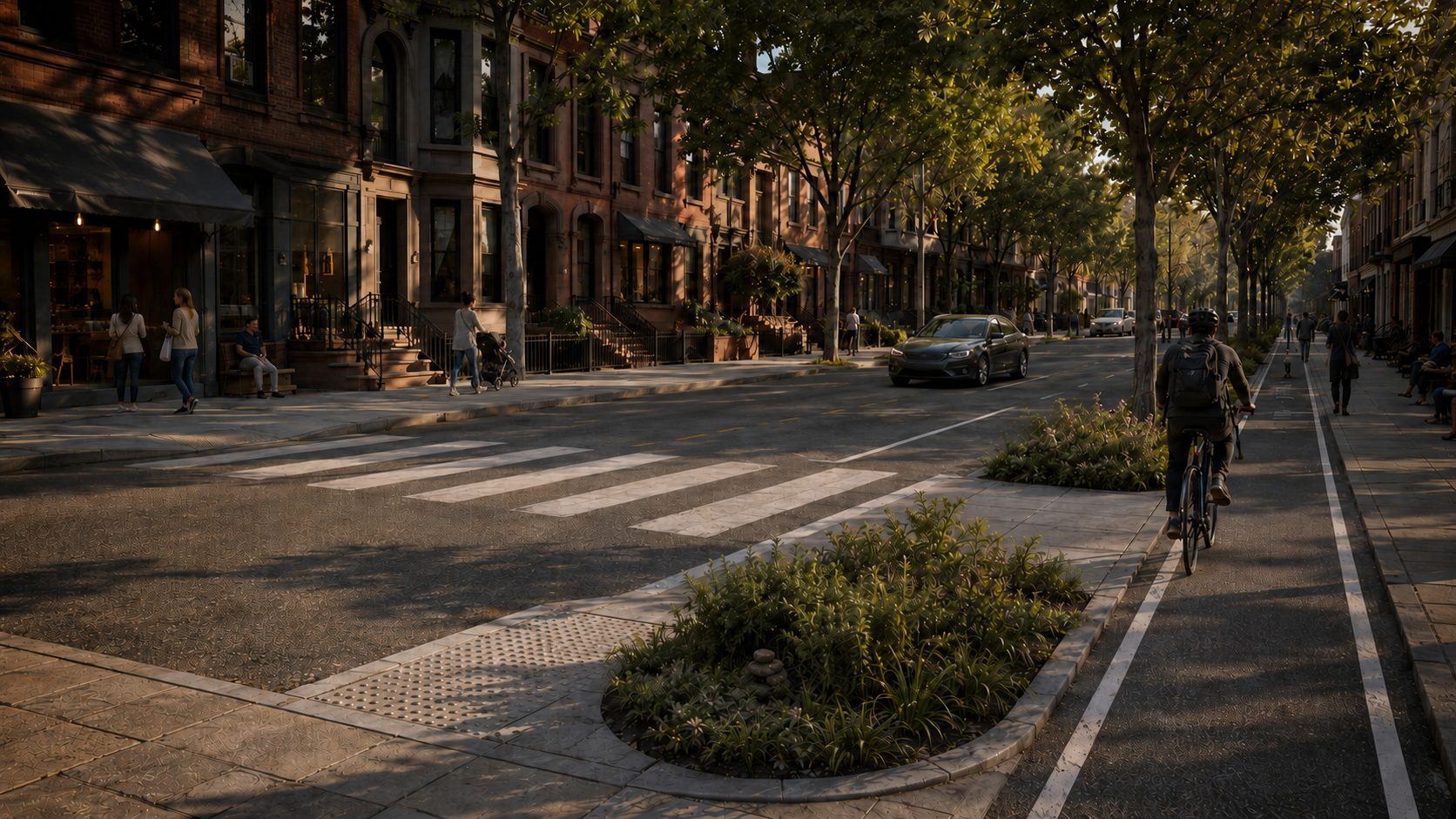
Hoboken, New Jersey, a dense small city across the river from Manhattan, sustained years without a traffic death. No single project produced that record. It came from a coordinated package of modest changes: clearing parked cars away from corners so drivers and walkers can see each other (a practice called daylighting), high-visibility crossings, curb extensions that shorten the distance a person is exposed, lower speed limits, and signals retimed to give people a head start.
Of those pieces, daylighting carries the clearest individual evidence: it was associated with roughly 30 percent fewer pedestrian injuries. The rest worked as a package, and the city is careful to describe it that way.
+1 mph
Each additional mile per hour of impact speed raises the odds of a pedestrian death by about 18 percent.
Source: Hussain et al., 2019
Why small changes carry so much weight
Speed sits underneath all of it. A meta-analysis of 20 studies covering more than 36,000 pedestrians found that each additional 1 mph of impact speed raises the odds of a pedestrian death by about 18 percent. The risk is around 5 percent at 19 mph and near 50 percent around 34 to 37 mph. The difference between a hard stop and a tragedy is often a handful of miles per hour, which is why a tighter corner, a clearer sightline, or a few seconds of head start can matter far more than their size suggests.
What to apply
The package logic travels even where the density does not. Any campus, business district or site entrance has corners where visibility is bought or lost, crossings where exposure is long or short, and approach speeds that design can lower without a single sign asking anyone to behave differently. Start where people already cross, and improve several conditions at once rather than betting on one.
The limit
Hoboken is compact and walkable, and its record belongs to the whole package. No single treatment can claim it alone, and results in more spread-out places will differ.
Sources: City of Hoboken Vision Zero program; Results for America case study; Hussain et al., Accident Analysis and Prevention, 2019.